
Anxiety or Trauma? When Anxiety Symptoms May Be Linked to Underlying Trauma
Many people seek support for anxiety without realising that trauma may also be contributing to how they feel.
They describe themselves as constantly stressed, emotionally reactive, overwhelmed, or permanently "on edge." Some struggle with panic attacks, overthinking, people-pleasing, or difficulty feeling safe in relationships. Others feel exhausted, as though they have been in survival mode for so long that it has become their baseline.
For some people, anxiety and trauma are both part of the picture and understanding this connection can open the door to more complete and effective support.
This does not necessarily mean a person has experienced one obvious or catastrophic event. Trauma can develop through a wide range of experiences including chronic stress, emotionally unsafe environments, childhood invalidation, unstable relationships, bullying, medical experiences, or prolonged exposure to conflict or unpredictability.
What Is Anxiety?
Anxiety is the body and brain's natural response to perceived threat or danger. However, when anxiety becomes chronic or disproportionate, it begins to affect emotional wellbeing, relationships, sleep, concentration, and quality of life.
Common symptoms include:
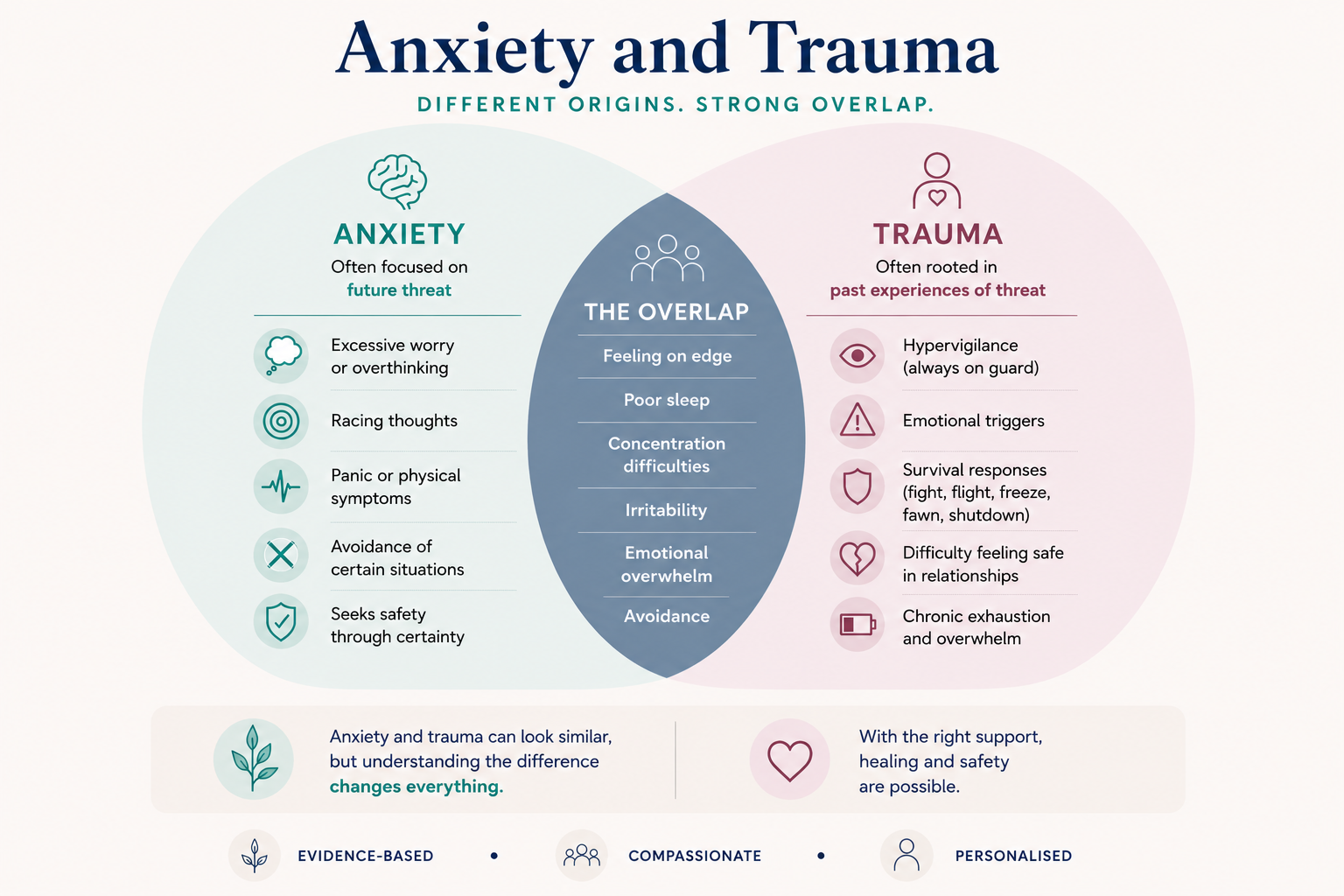
Excessive worry, racing thoughts, and overthinking
Muscle tension, restlessness, and panic attacks
Difficulty relaxing or switching off
Irritability, sleep disturbance, and avoidance
Feeling constantly "on edge"
Many people with anxiety feel caught in cycles of anticipating problems, scanning for danger, or preparing for worst-case scenarios, even when things are objectively stable.
When Anxiety May Also Be Linked to Trauma
Trauma can profoundly shape how the nervous system responds to stress, relationships, and perceived danger. And often in ways that closely resemble an anxiety disorder. For some people, what presents as anxiety reflects a nervous system that learned, at some point, that staying alert was necessary for survival.
This is why some people describe always feeling unsafe even when life is stable, becoming emotionally overwhelmed by situations others seem to manage easily or shutting down under pressure. In these situations, anxiety may be less about a thinking pattern and more about a nervous system that has not yet learned it is safe to rest.
What Is Trauma?
Trauma occurs when an experience overwhelms a person's capacity to cope emotionally, psychologically, or physiologically.
Trauma may result from:
Childhood emotional neglect or unpredictable caregivers
Bullying, social rejection, or unstable relationships
Medical trauma, accidents, or serious illness
Prolonged exposure to conflict, criticism, or invalidation
Sudden loss, grief, or persistent instability
Some people may minimise their own experiences because they feel their trauma "was not bad enough." But trauma responses are not measured by comparison. The nervous system responds based on perceived safety, threat, and emotional overwhelm, not on an objective scale of severity.
Key Signs Your Anxiety May Be Linked to Trauma
You Feel Constantly "On Guard"
Many people with unresolved trauma describe an inability to fully relax. Scanning for problems, anticipating conflict, feeling startled easily, and carrying near-constant tension are all signs of hypervigilance.
Your Emotional Reactions Feel Intense or Hard to Understand
Becoming overwhelmed quickly, shutting down emotionally, panicking during conflict, or reacting intensely to criticism or rejection are often automatic nervous system responses. They are understandable adaptations to past experiences of threat or emotional unsafety.
You Struggle to Feel Safe in Relationships
Unresolved trauma can significantly affect attachment, trust, and emotional safety in close relationships. Fear of abandonment, excessive people-pleasing, difficulty with boundaries, or avoiding emotional closeness are often learned survival strategies rather than conscious choices.
You Feel Exhausted All the Time
Chronic nervous system activation is physically and emotionally draining. Many people with trauma-related anxiety describe persistent burnout, mental fatigue, poor sleep, and a sense of being depleted by everyday responsibilities.
Certain Situations Trigger You in Ways You Cannot Explain
A person may know logically that they are safe, yet still experience panic, shutdown, or intense anxiety. This occurs because trauma responses are not driven by conscious reasoning. They are automatic nervous system reactions, often triggered by sensory cues, relational dynamics, or situations that unconsciously echo past experiences.
How Therapy Can Help
Effective therapy for trauma-related anxiety does not require a person to relive every difficult experience. For many, it involves something more foundational: helping the nervous system learn that safety and emotional regulation is possible.
Evidence-based therapy can support people to:
Understand the connection between past experiences and current emotional responses
Reduce chronic hypervigilance and nervous system activation
Process unresolved trauma safely and at a manageable pace
Improve emotional regulation, boundaries, and relational patterns
Reduce shame, self-blame, and self-criticism
Build a greater sense of safety within themselves and their relationships
Approaches including Cognitive Behavioural Therapy (CBT), Schema Therapy, Eye Movement Desensitization and Reprocessing (EMDR), Acceptance and Commitment Therapy (ACT), and trauma-informed somatic approaches can all be effective, depending on the individual's presentation and goals.
Trauma and Anxiety Support in Melbourne Bayside and Telehealth Across Australia
Reach Psychology provides evidence-based psychological support for adults experiencing anxiety, trauma, PTSD symptoms, panic, emotional overwhelm, and stress-related difficulties. Our trauma psychologist in Melbourne works with clients to understand the full picture of their experience and tailor treatment accordingly.
We offer in-person sessions in Highett, Melbourne Bayside, conveniently located near Brighton, Hampton, Sandringham, and surrounding suburbs. We also offer Telehealth appointments for clients across Australia.
Frequently asked questions
-
Yes. Trauma can significantly affect the nervous system and may contribute to chronic anxiety, hypervigilance, panic attacks, emotional overwhelm, and persistent difficulty feeling safe, even in the absence of an obvious current stressor.
-
Some indicators include feeling constantly on edge even when life is stable, strong or confusing emotional triggers, difficulty trusting others, emotional shutdown under pressure, or a persistent sense of unsafety that does not respond to reassurance or logic alone.
-
Anxiety generally involves excessive fear or worry about perceived future threats. PTSD involves a specific set of trauma-related symptoms, including flashbacks, intrusive memories, and hypervigilance which are connected to past experiences. Both can co-occur and both respond well to evidence-based treatment.
-
CBT, Schema Therapy, EMDR, ACT, and trauma-informed somatic approaches can all be effective. The most appropriate treatment depends on the individual's history and goals and is best determined collaboratively with a psychologist.